Tiny Jewel of the Woudenberg Forest (Netherlands): The Goldcrest or “Goudhaan”

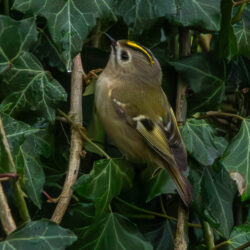
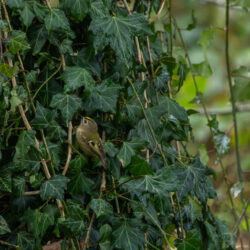
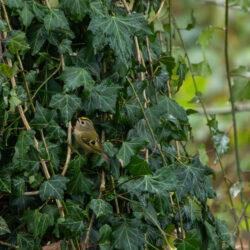
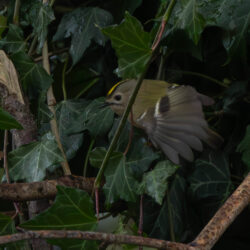
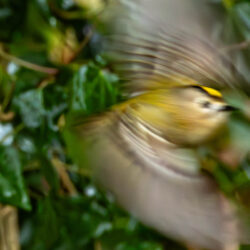
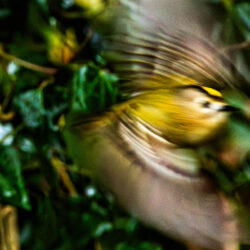
While wandering through the beautiful forests of Woudenberg in The Netherlands, I recently had the pleasure of spotting one of Europe’s smallest birds: the Goldcrest (Regulus regulus). This tiny gem, no bigger than your thumb, weiging not more than 40grams, is a constant flurry of activity, flitting amongst the branches in search of insects.
With its greenish upperparts and whitish underparts, the Goldcrest is easily identifiable by the two distinct white wingbars. But the real showstopper is its vibrant head crest. In males, this crest is a dazzling mix of orange and yellow, while females sport a bright yellow crown. This crest is particularly prominent during the breeding season, a flash of colour against the green foliage.
At first glance, the Goldcrest might be mistaken for its close relative, the Firecrest (Regulus ignicapilla). Both share similar European habitats, but a closer look reveals key differences. The Firecrest boasts distinctive bronze shoulders and
a striking facial pattern, features absent in the Goldcrest.
The Goldcrest’s song is a series of high, thin notes, pitched slightly higher than the Firecrest’s. It’s a delicate sound that often blends into the rustle of leaves. Interestingly, Goldcrests found on the Canary Islands have been classified into two distinct subspecies, highlighting the variations within this widespread species. These island birds were once considered closely related to the Firecrest or even a separate species altogether.
Preferring coniferous woodlands and gardens, the Goldcrest constructs a remarkable nest: a compact, three-layered structure carefully placed on a tree branch. The female diligently incubates a large clutch of ten to twelv
e eggs, and both parents share the responsibility of feeding the hungry chicks. Second broods are common, demonstrating the Goldcrest’s prolific nature.
These tiny birds are always on the move, tirelessly searching for insects to fuel their high energy levels. In winter, they often join flocks of tits, creating bustling mixed-species foraging groups. While they face threats from birds of prey and parasites, their large population and extensive range mean they are currently not a conservation concern.
Spotting this tiny jewel in Woudenberg was a true highlight. It’s a reminder that even the smallest creatures can bring immense joy and beauty to our natural world. Keep an eye out for these little dynamos on your next woodland walk and know that even winter birding can be rewarding!
Join our newsletter for more interesting articles on birding.